
Beginner woodworking tools: the 12 you actually need
What to buy for your first furniture and garden builds, why each tool earns its place, and what you can skip for now.
To build beginner furniture and garden projects from standard lumber, start with a tape measure, speed square, miter saw, cordless drill and impact driver, clamps, a random orbital sander and safety gear. A circular saw, a pocket hole jig and a pair of sawhorses round out the kit. Skip the table saw, router and planer until a project truly needs them.
Walk into a tool store as a beginner and it's easy to leave with a cart full of gear you won't touch for a year, and still be missing the one clamp you need halfway through your first build. That's the fastest way to waste a weekend.
This list of beginner woodworking tools is built around one kind of project: sturdy furniture and garden builds from standard lumber, like a workbench, a picnic table, a planter or patio chairs. That's where most people start, and it needs far fewer tools than you might think.
Measuring and marking
1. Tape measure
A 25-foot tape covers every project in this size range. Look for a wide blade that stays stiff when you extend it, and clear markings down to 1/16". Most cutting mistakes start as measuring mistakes, so this is the tool you'll use most.
2. Speed square
This little triangle draws square lines across a board in one motion, marks common angles, and doubles as a saw guide. It's inexpensive, nearly indestructible and you'll reach for it on every cut. Keep a carpenter's pencil with it.
Cutting
3. Miter saw
If you buy one power saw, make it a miter saw. It makes clean, square crosscuts in 2x4s, 2x6s and 4x4s every time, and it cuts angles for chair backs and planter trim. Since most cuts in furniture and garden projects are crosscuts to length, this saw does the bulk of the work. A 10" saw handles most boards; a 12" or sliding model handles wider ones.
4. Circular saw
A circular saw handles the cuts a miter saw can't: long rips down the length of a board and cuts across plywood sheets. Clamp a straight board to your workpiece as a guide and it will cut as straight as a much bigger saw. If your budget only allows one saw, a circular saw with a speed square as a guide can make every cut, it's just slower.
Drilling and joining
5. Cordless drill/driver
For drilling holes and driving smaller screws. An 18V or 20V drill with two batteries means you're never stuck waiting on a charger mid-build.
6. Impact driver
An impact driver drives long screws into 2x lumber with far less effort and fewer stripped screw heads than a drill. With both, you can keep a drill bit in one and a driver bit in the other instead of swapping all day. Many brands sell the pair as a kit with shared batteries.
7. Drill bits and a countersink bit
Drilling a small pilot hole before driving a screw near the end of a board stops it from splitting. A countersink bit lets screw heads sit flush with the surface so nothing snags. A basic set of twist bits plus one countersink covers it.
8. Clamps
Clamps are your extra pair of hands: they hold parts square while you drive screws and hold glued joints tight while they dry. Start with four: two 24" bar clamps and two 12" clamps. Every woodworker will tell you that you can never have too many, but four will get you through your first projects.
9. Pocket hole jig
A pocket hole jig drills angled holes so you can join boards with hidden screws, without complex joinery. It's one of the quickest ways for a beginner to make strong, clean-looking joints in tabletops, frames and shelves. Use coarse-thread pocket screws for softwoods like pine and cedar.
Sanding and finishing
10. Random orbital sander
Lumber from the store has rough spots, stamps and sharp edges. A random orbital sander smooths it quickly without leaving swirl marks. Work through 80, 120, then 180 grit and round over every edge a person might touch. For outdoor projects, that's usually as fine as you need to go before stain or sealer.
Safety gear and a work surface
11. Safety glasses, hearing protection and a dust mask
Not optional. Wear safety glasses for every cut, ear protection for the saws, and a dust mask when sanding or cutting, especially with pressure-treated lumber. Never wear gloves while running a saw: they can catch in the blade.
12. Sawhorses or a workbench
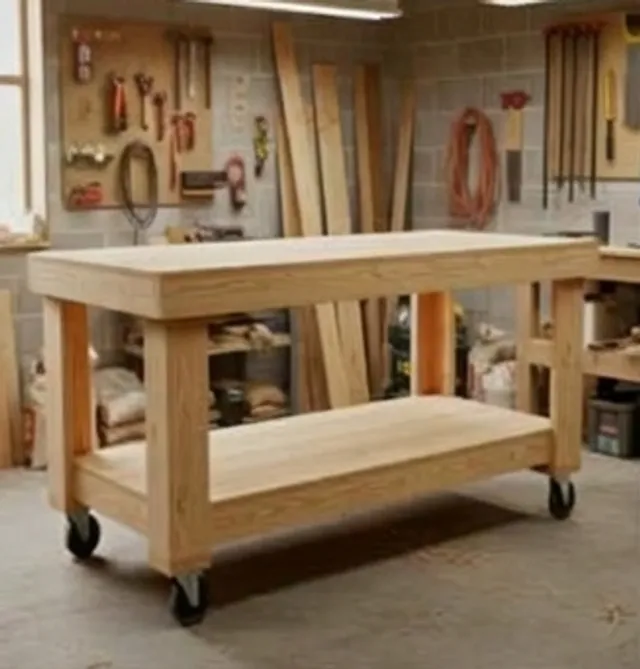
You need a flat, stable surface at a comfortable height. A pair of folding sawhorses with a sheet of plywood on top works for day one. A sturdy workbench is the upgrade, and it makes a great first build, since it uses exactly the tools on this list.
Nice to have later: a jigsaw for curved cuts, a 2-foot level, a combination square for precise layout, and a shop vacuum.
Tools you can skip for now
- Table saw. Powerful, but expensive, bulky and the shop tool that demands the most respect. Furniture from standard lumber rarely needs one.
- Router. Great for decorative edges and joinery, but your sander can round over edges well enough to start.
- Thickness planer and jointer. These turn rough lumber into finished boards. Home improvement store lumber is already surfaced, so you don't need them yet.
- Specialty hand tools. Chisels and hand planes are a joy to use, but buy them when a project actually calls for them.
Start with the right project
The tools only matter if they turn into something finished. Pick a first project that uses standard lumber, mostly straight cuts and screws, and can be built in a weekend. Before you buy wood, read our lumber size chart so the boards you bring home match your measurements, and if your project is going outside, see our guide to the best wood for outdoor furniture.
Every RigalShop plan includes a recommended tools list, so you know exactly which of these you'll need before you start a project.
Frequently asked questions
What tools does a beginner woodworker need?
For furniture and garden projects from standard lumber: a tape measure, speed square, miter saw, circular saw, cordless drill, impact driver, drill and countersink bits, clamps, a pocket hole jig, a random orbital sander, safety gear and a pair of sawhorses or a workbench.
What is the first power tool I should buy?
A cordless drill/driver. Almost every project needs holes drilled and screws driven. For cutting, a miter saw handles most crosscuts in 2x lumber, while a circular saw is the most versatile single saw if your budget only allows one.
Do I need a table saw to start woodworking?
No. Furniture and outdoor projects built from home improvement store lumber can be made with a miter saw and a circular saw. A table saw is expensive, takes up space and is best added once a project truly needs it.
Should I buy a miter saw or a circular saw first?
If most of your cuts are crosscuts to length in 2x4s and 2x6s, buy a miter saw for fast, square cuts. If you'll cut plywood or long boards along their length, start with a circular saw, which can make every cut with a straightedge guide.
Get a free woodworking plan
75 step-by-step plans with cut lists and 3D diagrams are launching soon. Join the early access list and the first 100 members get a free plan.
No spam, ever. Unsubscribe anytime. Privacy policy.